Brand & Communications Audit
A comprehensive assessment of the brand’s current state — positioning, visual system, tone of voice, and touchpoints. Highlights inconsistencies, gaps, and opportunities for improvement.
Brand & Communications Audit
Over time, a brand can lose coherence: the visual identity drifts from strategy, the website fails to convey value, and communication across channels speaks in different voices.
An audit brings the full picture together and shows where the brand loses strength. We assess it from three angles at once — audience, market, and business: how clearly the offer is understood, whether it stands apart from competitors, how well the visual system works, how consistent the tone is, and how convincing the brand feels across website, social media, presentations, advertising, and other touchpoints.
The goal is not to find flaws for the sake of it, but to identify what can be strengthened. Sometimes a full rebuild is needed. Sometimes it’s enough to clarify the value, align assets, remove visual noise, or refine key materials.
The result is a clear view of the brand’s current state: what works, what weakens perception, where gaps appear — and which changes will have the strongest impact on perception, trust, and sales.

Qualitative Research
In-depth exploration of audience perception and behavior through interviews, focus groups, and observation. Reveals motivations, attitudes, and hidden drivers behind decisions.
Qualitative Research
Sometimes, to make the right decision or build compelling communication, it’s not about measuring averages — it’s about understanding how people actually think: how they choose, hesitate, compare, justify a purchase, and what they truly perceive in a brand.
We work with interviews, in-depth conversations, observations, focus groups, and analysis of open responses. Patterns emerge: fears, barriers, expectations, unmet needs, audience language, and real decision drivers.This is especially relevant when entering a new market, repositioning, launching a product, testing hypotheses, or when communication isn’t landing. We also handle complex products and conduct interviews with decision-makers in high-barrier industries.
The result is a clear picture of perception: how the audience sees the category, what’s missing, what builds trust, what repels — and which insights can anchor strategy, identity, product, and communication.

Quantitative Research
Data-driven analysis of patterns at scale. Surveys, segmentation, and metrics used to validate hypotheses and measure market dynamics.
Quantitative research
When it’s not enough to hear individual opinions but necessary to understand scale — how many people think the same way, which patterns dominate, and which conclusions can be validated with data — we turn to quantitative research.
It’s especially useful before a product launch, rebranding, market entry, communication shift, or when testing multiple strategic directions. It helps separate intuition from verified data and reduces the risk of decisions based only on assumptions.We work with surveys, questionnaires, segmentation, statistics, user data, and market metrics. This allows us to test hypotheses, assess demand, compare audiences, identify priorities, and understand which factors truly drive decisions.
The result is a structured, data-backed view: how opinions are distributed, which segments are most перспективны, what builds trust, drives purchase or rejection, and which insights can inform strategy, product, brand, and communication.
Brand Strategy
A structured framework that defines the brand’s role, priorities, and direction. Connects business goals with market context and audience perception.
Brand Strategy
Brand strategy is needed when a project has to define where it is going and what will make it win. It becomes the working foundation for positioning, identity, product, marketing, sales, and communication.
We analyze the market, competitors, audience, product, business model, growth points, and constraints. We look at who already holds strong positions, where there is open space, what the audience chooses today and why, and which arguments can actually work.
The strategy defines the brand’s role in the market: who needs it, what problem it solves, how it differs, what value it promises, and what language it should use. We also define brand character, key messages, communication principles, and possible growth directions.
The result is not an abstract “big idea,” but a decision-making document: what to say on the website, how to structure a presentation, what the visual system should be built on, which meanings to strengthen in advertising, and how to explain the brand to clients, partners, and the team.
Brand Platform & Positioning
A clear articulation of what the brand stands for — its values, character, promise, and point of difference. Forms the foundation for all communication.
Brand Platform & Positioning
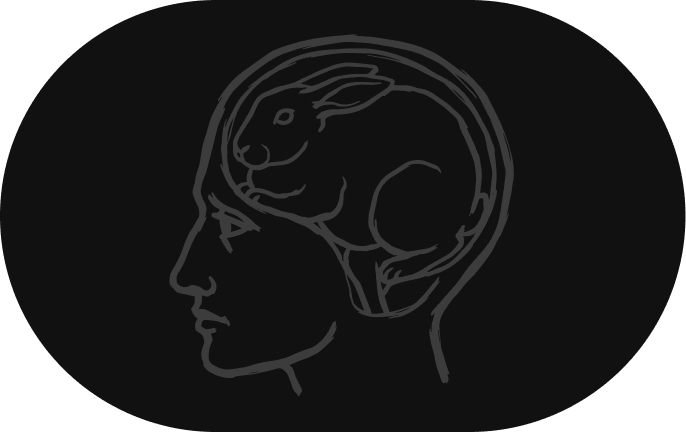
If strategy answers where the brand is going, the platform defines how it explains itself to the world.
The brand’s meaning is articulated in precise terms — not as a vague feeling, but as a clear structure: who we are, who we’re for, why we exist, what value we provide, and how we should sound.Positioning defines the brand’s place in the audience’s mind. It clarifies how the brand differs from competitors, which argument should be understood first, and why it’s easier to choose this brand over others.
The platform brings together key elements: brand essence, promise, values, character, tone of voice, messages, and both emotional and rational drivers. These become the foundation for the website, presentations, advertising, identity, packaging, and sales.

Creative Strategy
Principles and logic behind how the brand expresses itself. Covers tone, visual approach, and behavior across channels.
Creative Strategy
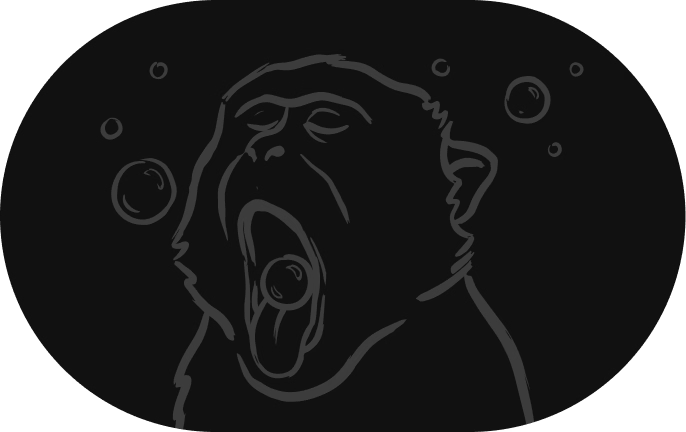
Creative strategy translates brand meaning into clear communication principles. It defines how the brand turns into campaigns, content, advertising, presentations, and visual ideas — so it doesn’t sound different every time.
It determines which themes fit the brand, what type of creativity supports its character, how it captures attention, and where the line sits between “on-brand” and “beautiful but irrelevant.”
We define the brand’s creative behavior: tone, visual language, level of boldness, communication rhythm, formats, mechanics, and ideas that can evolve across channels. We also develop and curate special projects — from concept and format to collaborators, visual direction, and execution.
Presentations & Infographics
Clarity-first visual communication. Complex ideas translated into structured layouts, strong hierarchy, and readable narratives.
Presentations & Infographics
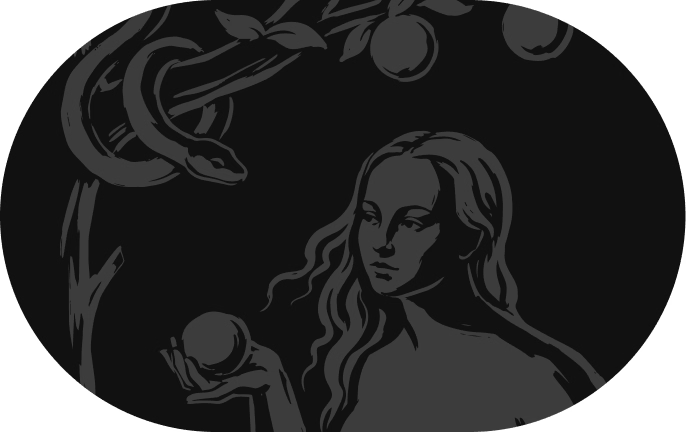
We work with structure, narrative logic, copy, visual hierarchy, charts, diagrams, infographics, and illustration. Complex information is turned into a clear story: what matters, in what order it should be shown, where emphasis is needed, and what should be removed.
We create investor pitches, commercial proposals, brand presentations, reports, research decks, internal documents, and strategic materials.
A presentation should not just place information on slides beautiful. Its purpose is to guide a person through an idea — quickly, clearly, and convincingly. Without overload or loss of attention. So the audience understands, remembers, and can make decisions.
Financial Models
A practical view of the project’s economics — revenue streams, cost structure, and growth scenarios. Built to support decision-making.
Financial Models
A financial model helps evaluate a project’s economics before significant time, money, or resources are committed. It shows where revenue comes from, where costs emerge, how profitability changes over time, and which conditions make the business sustainable.
We build models tailored to specific goals: product launches, new ventures, investment pitches, development projects, hospitality, e-commerce, services, or business expansion. Models include revenue streams, costs, margins, seasonality, growth scenarios, payback periods, and key risks.
The model helps identify which metrics truly matter, where the break-even point sits, how many sales are required, how resilient the business is, and which decisions have the greatest impact on outcomes.
Localization
Adaptation for new markets with attention to language, cultural context, and user expectations. Maintains consistency while adjusting perception.
Localization
Localization becomes essential when a brand enters a new country or communicates with audiences shaped by a different language and cultural context. Direct translation is not enough — the meaning, tone, and feeling of the brand must remain intact.
We adapt copy, naming, slogans, interfaces, packaging, and communication so they feel natural to the new audience without losing character. The process takes language, cultural codes, behavior patterns, sensitivity to wording, and visual perception into account.
Local experts — native speakers and market specialists — are involved throughout the process. This helps avoid inaccuracies, simplify adaptation, and make communication feel more organic.
The result is a brand that feels native to the new market: clear, relevant, and aligned with audience expectations.
Brand Naming
Names built on strategy, sound, and scalability. Designed to work across markets and hold long-term relevance.
Brand Naming
A name is the first point of contact with a brand. It should be simple enough to remember, precise enough to avoid randomness, and strong enough to scale with the brand.
The process is built on the brief, strategy, and audience understanding. At this stage, we define the nature of the name: direct or metaphorical, local or universal, neutral or expressive.We then develop several directions, each with a curated set of 7–20 options. Every name comes with a rationale — meaning, phonetics, and communication potential.
Final options undergo initial checks: domain availability, social handles, category overlaps, and basic registrability.
The result is a name that fits the strategy, resonates with the audience, and holds its meaning as the brand grows.

Brand Tagline (Slogan)
Short-form messaging that captures the core idea of the brand. Focused, memorable, and aligned with positioning.
Brand Tagline (Slogan)

A phrase at the core — built to endure repetition without losing strength. It can act as a brand signature, the voice of a campaign, or a concise way to express why the brand exists.
Beyond meaning and phrasing, we focus on behavior: how it sounds aloud, how it sits in layout, how easily it’s remembered, and how well it works next to the logo, in ads, on packaging, across the website, or in product launches.
We search for a formula where idea, tone, and communication intent converge. Sometimes the line is direct and explanatory. Sometimes it’s emotional, cultural, bold — or almost invisible, yet shaping perception.
The result is a concise line with a clear role: it strengthens the brand, differentiates it, and brings focus to communication.
Brand Story (Legend)
A coherent story that gives the brand depth and meaning. Frames its origin, intent, and perspective.
Brand Story (Legend)
A narrative that gives the brand depth: where it comes from, what it believes in, why it speaks the way it does, and the place it aims to occupy in people’s lives.
It can be rooted in the project’s origin, the founder’s personality, cultural context, product logic, or a constructed world around the brand. What matters is that it doesn’t feel decorative — it should reinforce meaning and help the audience quickly sense the brand’s character. In some cases it reads almost documentary; in others, more mythic, atmospheric, or cinematic.
The result is a coherent story that can be used across the website, presentations, brandbook, packaging, PR materials, and communication. It makes the brand more alive, memorable, and emotionally precise.
Logos
Distinctive marks shaped by the brand’s character. Designed for recognition and flexibility across formats.
Logos
A logo is where the brand compresses into a single form. It should read instantly, hold character, and retain strength at any scale.
Before designing, we break the brand down as a system: meaning, positioning, behavior, and the visual field of the category. We define what the form needs to be — rigid or soft, strict or expressive, technological or tactile, quiet or bold.
Based on this, we develop 2–3 logo concepts. Each tests a distinct visual hypothesis — through symbol, typography, icon, or a more complex graphic metaphor. This reveals which expression translates the brand most precisely into form.
We also test how the logo performs in real contexts: small sizes, packaging, website, signage, presentations, motion, and digital environments. The mark must stay recognizable, hold together in detail, and integrate seamlessly into the broader identity.
The result is a strong trademark that conveys the brand idea, stands out from category noise, and can grow into a lasting brand asset.
Visual Identity
A unified system of colors, typography, and graphic elements. Ensures consistency across all touchpoints.
Visual Identity
This is the moment when the brand gets its appearance.
We start with tone. We treat the brand as a living presence: how it moves, how loud or restrained it is, whether it feels strict, sensual, bold, calm, or even strange. This helps avoid random aesthetics and build a visual language with a clear, unified character.
Then strategy takes form. We define which visual codes shape perception: what should be understood instantly, what should be remembered, where clarity is needed, and where the brand requires emphasis, gesture, or energy.
The identity is designed as a system. It should look strong, but more importantly — work across formats: website, packaging, presentations, social media, environments, navigation, merchandise, and digital products.
Once a direction is chosen, we refine the system: color palette, typography, graphic elements, composition, photography, materials, and, if needed, motion or 3D.
The result is a cohesive visual language that makes the brand recognizable, distinct, and precise in how it feels. The system is finalized in guidelines, so it can be applied consistently and developed further.
Packaging Design
Packaging as part of the product experience. Balances function, perception, and shelf impact.
Packaging Design
This is where the brand becomes a physical object. It’s picked up, seen on the shelf, opened, kept, gifted, photographed — and this is where the visual system is tested through real interaction.
We design packaging with the category, product, buyer behavior, and sales environment in mind. It’s not just about how it looks, but how it works: whether it gets noticed, whether the product is understood instantly, whether it conveys value, and whether it stands apart from others on the shelf.
We consider form, materials, structure, color, typography, information hierarchy, labeling, SKU systems, shelf navigation, and production constraints.

Typeface Design
Custom or adapted type systems aligned with the brand’s visual language and functional needs.
Typeface Design
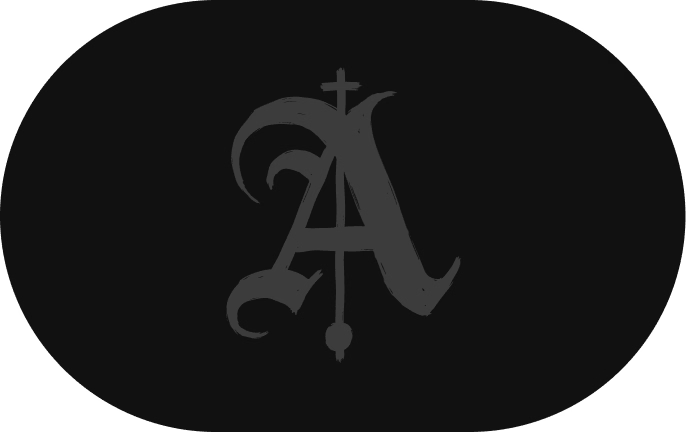
The same text can feel premium, dry, technological, naive, aggressive, or calm — simply through typeface, proportions, and rhythm.
The goal is to build a typographic system that is easy to read, practical to use, and distinct in character. We don’t just pick a “nice font.” We consider how text lives in real contexts: logo, headlines, packaging, interfaces, presentations, navigation, social media, and long-form content.
Depending on the task, we define a type system: a curated font pair, an adapted existing typeface, or custom elements — letters, numerals, accents, logotype typography, and composition rules.
Illustrations
A tailored graphic layer that supports communication and strengthens visual identity.
Illustrations
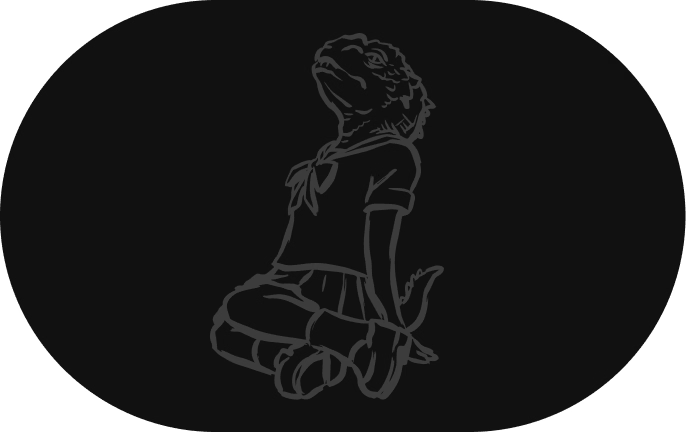
Not everything in a brand can be explained through photography, text, or a logo. Sometimes it needs a separate visual layer — more figurative, flexible, and free.
Illustration helps a brand explain a complex idea, add emotion, or build its own world around the product. This may include characters, graphic scenes, patterns, icons, decorative elements, technical diagrams, or art-driven graphics.
We define a style that doesn’t feel like a random image placed next to the brand, but becomes part of its language — through line, color, form, level of detail, mood, and logic of use.
CGI & 3D
Advanced visual assets for digital environments, campaigns, and product representation.
CGI & 3D
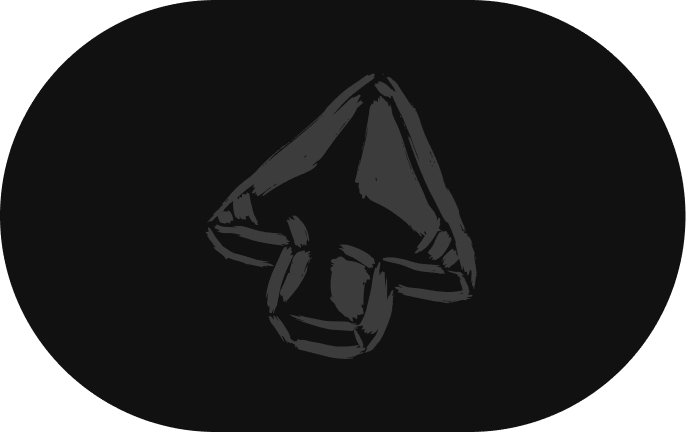
Some visuals are impossible — or too expensive — to produce with a camera: ideal product scenes, complex materials, abstract worlds, motion graphics, environments, and campaigns with full control over the image.
It’s not just about making something look good, but about matching the brand precisely: light, texture, scale, form, level of realism, color, composition, and how objects behave in the frame.
We create product renders, packaging visualizations, digital objects, key visuals, animation, 3D illustrations, campaign scenes, and assets for websites, presentations, social media, and advertising.
Spatial Design & Wayfinding
Branded physical environments with clear navigation and considered user flow.
Spatial Design & Wayfinding
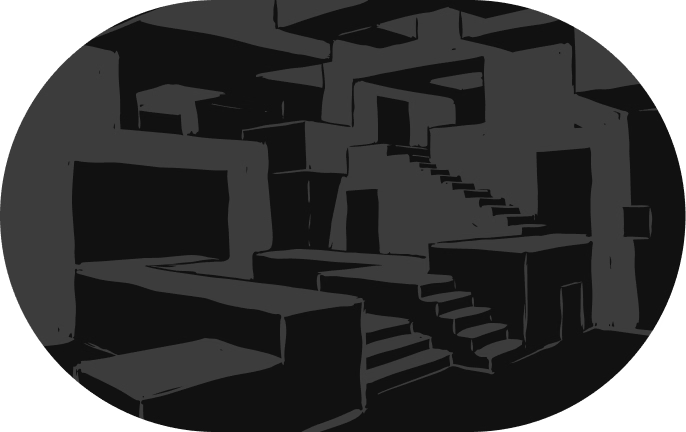
A physical space is where the brand stops being an image and becomes an experience. Scale, materials, light, graphics, displays, counters, walls, and routes shape the perception — whether it feels premium, urban, technological, intimate, or bold.
We design environments as systems: concept, zoning principles, surface graphics, storefronts, counters, fitting rooms, reception areas, pop-ups, exhibition stands, restaurants, and retail spaces.
Wayfinding is added as a functional layer — helping people understand the space, locate key areas, and move through it without friction.
A well-designed space doesn’t just “look on brand.” It drives sales, directs attention, highlights key zones, enhances the product experience, and creates a place people want to return to — or share.
Brand Books & Guidelines
A structured system of rules and references for consistent brand application.
Brand Books & Guidelines
A brand book ensures the brand doesn’t depend on one designer, one file, or one presentation. It defines the system: how to use the logo, colors, typography, graphics, photography, composition, packaging, digital assets, and communication.
We create not a formal document for storage, but a working tool for teams, partners, and future launches. It should clearly define what’s allowed, what isn’t, how to build new layouts, and how to keep the brand consistent across formats.
Guidelines can be compact or detailed, depending on the scale. Some brands need only core rules, others require a full system: applications, templates, tone of voice, layout principles, misuse examples, and rules for social media, presentations, packaging, environments, and digital products.
A strong brand book saves time, reduces chaos, and keeps the brand consistent — even when multiple people work with it.
Creative Concept
Idea systems that define the direction of campaigns, launches, and content. Built to attract attention and sustain engagement.
Creative Concept
A central idea that shapes a campaign, launch, special project, or a series of communications. It defines what the brand says, how it captures attention, and why the message stays.
A concept must extend beyond a single execution. It can scale into digital formats, outdoor, social media, video, packaging, spatial design, PR materials, or brand activations.
A strong concept is easy to explain internally, clear to the audience, and holds across multiple touchpoints without losing meaning.
The result is a defined idea with clear logic, tone, and visual principles, along with suggested formats and execution examples.
Art Collaborations
Collaborative projects with artists and creatives that extend the brand into a broader cultural context.
Art Collaborations
This format helps brands move beyond standard communication and enter the cultural space — through artists, illustrators, photographers, 3D creators, designers, musicians, and other creatives.
We work with a curated network of artists across disciplines, selecting collaborators based on brand character, task, audience, and desired level of boldness. The outcome can take many forms: limited collections, visual series, art objects, spatial design, digital projects, merchandise, packaging, exhibitions, or special projects.
The goal is not to place an artist next to a brand, but to find a real intersection — where the author’s language strengthens the brand’s idea, and the brand provides a clear context and a strong platform.
The result is a collaboration with a clear concept, the right author, and a format that works as a cultural statement, a visual asset, and a more engaging way to connect with the audience.
AI Production
Content and visual production powered by AI tools. Enables faster iteration, flexible formats, and expanded creative possibilities.
AI Production
AI production solves tasks where brands need fast, flexible, and visually strong assets without full-scale shoots or long 3D pipelines.
Using generative tools, we create key visuals, campaigns, image series, mood films, product scenes, fashion shoots, interior visuals, and rapid concept tests.
We treat AI as a production environment: art direction, prompt building, and control over style, composition, materials, faces, lighting, scenes, and brand alignment. The goal is not a random nice image, but a controlled visual result.
The output is brand-aligned visuals in the required format — faster, more flexible, with room for experimentation, but guided by art direction and driven by the brand’s goals.
Brand Digital Environment
Corporate websites, internal portals, and brand platforms with intuitive content management systems. Designed for clarity, scalability, and day-to-day usability.
Brand Digital Environment
We develop corporate websites and digital platforms tailored to the project’s needs — from simple setups to complex systems. Depending on the goals and scale, we work with Bitrix, Tilda, WordPress, low-code tools such as Webflow or Bubble, or fully custom development using modern frameworks.
The technology stack depends on the task: sometimes speed matters most, sometimes flexibility, and sometimes full control over functionality.
The result is a digital environment that works as a stable system — easy to manage, scalable, and able to grow alongside the business.
Landing Pages & Promo
Landing pages, promo sites, and campaign environments for product launches and brand activations. Includes media-driven formats, interactive experiences, and special projects.
Landing Pages & Promo
Landing pages and promo sites are fast entry points into an idea, product, or campaign. There are no unnecessary layers: within a few screens, the user should understand what it is, why it matters, and what to do next.
These formats are built around specific moments — product launches, campaigns, special projects, collaborations, events, or hypothesis testing. Structure, copy, visuals, and mechanics are shaped around the goal, whether it’s conversion, engagement, or explaining a complex offer.
We use interactive blocks, motion, unconventional layouts, video, playful mechanics, and media-driven solutions — anything that helps hold attention and amplify impact.
A landing page may not live long, but it has to work precisely: engage quickly, communicate clearly, and drive action.
Applied in Real Projects:
E-commerce
Online stores and retail platforms built around conversion, product presentation, and operational efficiency. Includes consulting on business processes beyond development.
E-commerce
We build e-commerce as a clear purchasing system: catalog structure, categories, product pages, filters, cart flow, checkout, and repeat purchase scenarios. We remove unnecessary actions, simplify choice, and shorten the path from entry to payment.
Special attention is given to product presentation: photography, copy, specifications, variations, and related products. Everything should support decision-making, not overload it.
We work not only with the interface, but also with the surrounding processes: assortment structure, promotions, product management, payment systems, delivery, and CRM integrations.
We can build a platform from scratch or rebuild an existing one — improving conversion, usability, and operational control.
UX/UI Design & Mobile Development
Cross-platform mobile applications built with a focus on performance, usability, and business goals.
UX/UI Design & Mobile Development

An interface is how a product behaves in the user’s hands. If it creates friction, confusion, or unnecessary steps, people leave — no matter how strong the brand is.
We design screen logic, user flows, and product structure so the journey feels intuitive from the first interaction to the final action. We remove unnecessary steps, simplify decisions, and shape the rhythm of interaction.
We work with mobile apps and digital products of varying complexity — from lightweight services to multi-layered platforms with accounts, payments, bookings, catalogs, maps, subscriptions, and complex user scenarios.
The result is an interface that doesn’t need explanation. It guides users naturally and keeps focus on the task.
Digital Products
End-to-end product development: research, product strategy, UX/UI design, development, and growth roadmap. Covers the full lifecycle from concept to launch and scaling.
Digital Products
We build digital products end-to-end — from the initial hypothesis to launch and long-term growth.
The process starts with research: defining product strategy, audience, user scenarios, features, and business logic. From there, we design UX/UI, build the technical structure, support development, and plan post-launch scaling.
Our expertise covers product analytics, strategy, prototyping, interface design, development, and product launches. We can lead the entire process or join at specific stages.
Success (´・ᴗ・ ` ) Request received
Please check and try again. ~(>_<~)